Where Does My Family Story Begin? -A Beginner's Guide to Discovering Your Roots

What if the answer to “Where do I come from?” is already sitting in a photograph, a family Bible, an old record, or a story you've heard your entire life?
Most families have stories.
Perhaps your grandmother told you that her parents came from South Carolina. Maybe your father mentioned a relative whose name you can barely remember. Perhaps there is an old photograph tucked away in a box with names written faintly on the back.
At the time, those details may not have seemed important.
Then one day, something changes.
You find yourself wondering:
Who were the people who came before me? Where did they live? What did they experience? And how did their lives eventually lead to mine?
That is often where genealogy begins—not with a database or a perfectly completed family tree, but with a question.
The Problem: You Want to Know Your Family History, but Where Do You Start?
Beginning genealogy can feel overwhelming.
You may know your parents and grandparents but very little beyond them. You might have several family names but aren't sure how everyone is connected. Perhaps relatives have passed away, taking important family stories with them.
Then you search online.
Suddenly you're looking at census records, birth certificates, marriage records, death certificates, obituaries, military records, cemetery listings and thousands of names.

Instead of finding answers, you may end up with even more questions.
Which person is my ancestor?
How do I know this is the right family?
Why are there different spellings of the same surname?
Why can't I find the person I'm looking for?
These are normal questions for beginning family historians.
Genealogy isn't simply about finding someone with the same last name. It is about carefully following evidence from one generation to the next.
And sometimes the smallest clue can open an unexpected door.
It Can Begin with One Name
Imagine opening an old family box and finding a photograph.
You don't recognize the people, but someone wrote a name on the back many years ago.
You begin searching for that name.

Eventually, you find the person listed in a census record.
There are other people living in the household.
A husband.
A wife.
Children.
Perhaps an elderly parent.
Now you have several more names.
You search for one of the children and discover a marriage record. That record gives you another surname. An obituary identifies brothers, sisters and other relatives. A cemetery record provides dates you didn't have before.
One clue leads to another.
Before long, that faded photograph isn't simply a photograph anymore.
Those people have names.
They lived somewhere.
They belonged to families.
They worked, married, raised children, experienced hardships, celebrated milestones and made decisions that affected the generations who followed them.
Suddenly, you're not simply collecting records.
You're discovering a family.
The Discovery: Your Family Tree Is More Than Names and Dates
One of the most meaningful discoveries in genealogy is realizing that a family tree isn't really about a tree.

It's about people.
Dates help us organize their lives. Documents help us prove relationships. But the real treasure is discovering the stories behind those facts.
A census record may tell you where your ancestors lived.
A marriage certificate may connect two families.
A death certificate may reveal the names of another generation.
An obituary may introduce siblings and relatives you never knew existed.
A deed may show where a family established a home.
A newspaper article may provide a glimpse into everyday life.
And an old photograph may allow you to look into the face of someone whose life helped make your own possible.
This is when genealogy becomes something deeper.
You begin asking different questions.
Instead of simply asking, “When was this person born?”
You begin asking:
“What was happening in their life?”
Instead of only asking, “Where did they live?”
You wonder:
“Why did the family move?”
And instead of simply adding another name to your family tree, you begin wondering:
“What story does this person have to tell?”
That is where family history comes alive.
The Solution: Begin With What You Already Know
You don't need to know everything before beginning your genealogy journey.
In fact, one of the best places to begin is with yourself.
Write down your full name, birth information and important life events. Then add your parents.
Next, add your grandparents.
Record what you know before worrying about what you don't know.
Then begin gathering information from your family.
Talk with parents, grandparents, aunts, uncles, cousins and older relatives. Ask about names, places, marriages, occupations, traditions and stories.
Look around your home for family-history clues.
Old photographs, letters, funeral programs, newspaper clippings, family Bibles, military papers, certificates and handwritten notes can all contain valuable information.
Once you have gathered what your family already knows, begin comparing those stories with historical records.
Look for records that help connect one generation to the next.
And most importantly, keep track of where your information came from.
A family story can provide a wonderful clue, but whenever possible, look for documents and other reliable evidence that support the connection.
Don't Rush the Journey
Genealogy can be exciting, especially when you make a discovery.
But family history isn't a race.
You may spend days searching for one ancestor and find nothing. Then a single record can suddenly answer a question you've had for years.

Some branches will be easier to trace than others.
Some questions may remain unanswered.
And occasionally, you may discover something completely different from the family story you grew up hearing.
That's part of the journey.
Approach your research with curiosity.
Follow the evidence.
Document what you find.
And remember that every generation you identify represents real people—not simply spaces on a pedigree chart.
What Will You Discover When You Follow Your Family Roots?
Perhaps you will discover where your ancestors lived.
Maybe you'll uncover a forgotten branch of the family.
You might finally identify the people in an old photograph.
Perhaps you'll discover why your family moved from one state to another.
Or you may uncover the story behind a surname you've carried your entire life.
But there is another reason to research your family history.
The stories you discover today can become the family history someone else inherits tomorrow.
One day, a child, grandchild, niece, nephew or distant cousin may ask the same question:
“Where does my family story begin?”
Because you took the time to research and preserve what you discovered, they may have an answer.
Your Family Story Is Waiting
You don't need a completed family tree to begin.
You need a name.
A question.
A photograph.
A memory.
A story.
Start there.
Follow one clue at a time and allow each discovery to lead you toward the next generation.
Because somewhere among those names, records and stories are people whose lives became part of your family's journey.
Your family story didn't begin with you—but you can help make sure it isn't forgotten.
Continue Your Genealogy Journey with Book Serenity
If you're ready to explore family history more deeply, discover genealogy books created to help preserve the people, connections and stories that shaped generations.
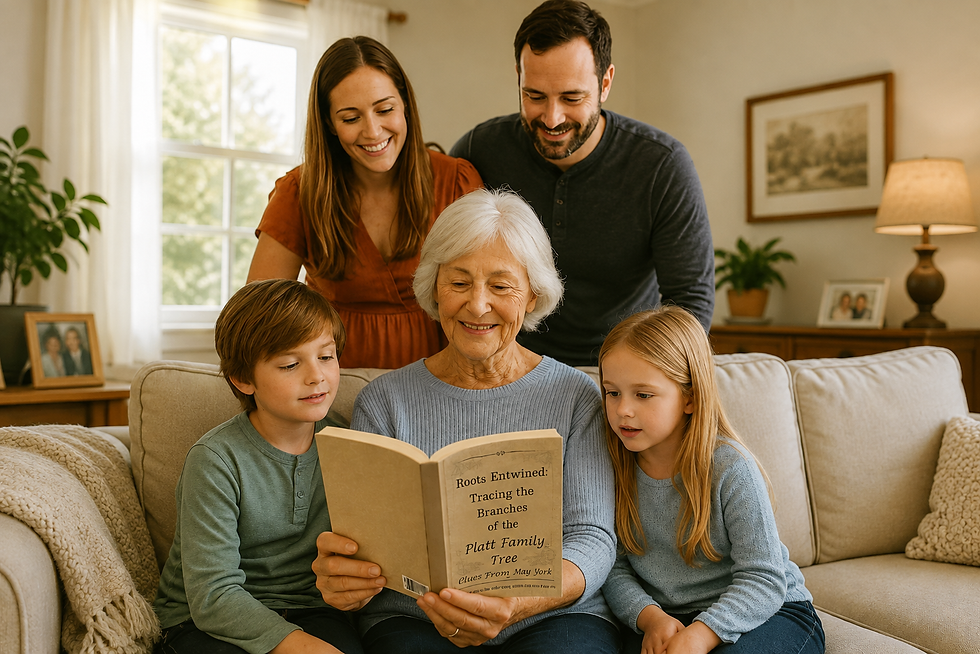
Explore South Carolina Genealogy of the Vanderhorst Family and Roots Entwined: Tracing the Branches of the Platt Family Tree.
Visit Book Serenity at www.bookserenity.com and begin discovering the stories waiting within your family tree.


Comments